
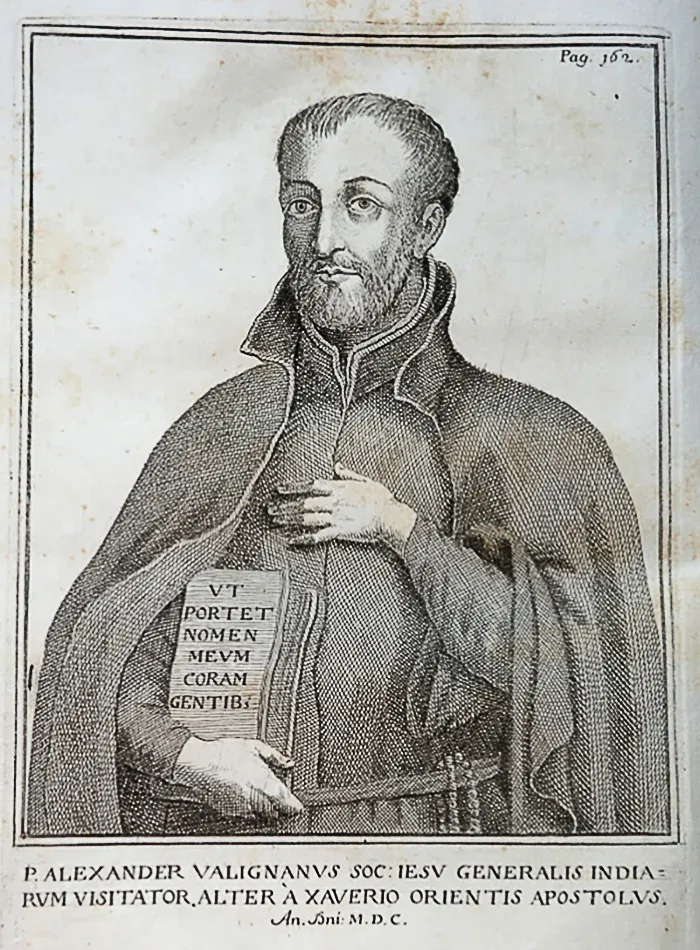
An Italian Jesuit and Visitor of the Society's missions in the East Indies. He reached Macau in 1578 and made the city his command centre for Jesuit work across Asia. In 1594 he founded St. Paul's College in Macau, regarded as one of the earliest Western-style colleges in East Asia. Macau's role as the gateway of the Catholic China mission is largely his doing. He died and was buried in Macau in 1606.
An Italian Jesuit who turned Macau into the command centre of the Far East mission — and whose St. Paul's College made the small city a gateway for missionaries entering China.
Alessandro Valignano was the Jesuit Visitor to the East Indies and the founder of St. Paul's College. Macau's role as the gateway of the Catholic China mission is largely his doing.
Profile
- Chinese Name: 范禮安
- Western Name: Alessandro Valignano (Portuguese: Alexandre Valignano)
- Born: 1539 (Chieti, Kingdom of Naples, Italy)
- Died: 20 January 1606 (Macau)
- Region: Italy / Macau · East Asia
- Domains: Culture · Religion · Education
- Subject type: Historical figure · Jesuit Visitor
Background
Valignano was born in 1539 in Chieti, in the Kingdom of Naples. After joining the Society of Jesus he was given responsibility for the missions of the East. In the late sixteenth century Portugal's maritime routes carried the Catholic mission into Asia, and Macau sat at a key node of that network. Valignano's work unfolded within this structure.
Career
I. Visitor of the East Indies; arrival in Macau (1578)
In September 1578 Valignano arrived in Macau as Visitor of the Society's missions in the East Indies — a powerful office charged with overseeing and, where needed, reorganising Jesuit work across Asia and answering directly to the Superior General in Rome. From then on Macau became his command centre for coordinating missions throughout Asia.
II. Founding St. Paul's College (1594)
In 1594 Valignano founded St. Paul's College (Colégio de São Paulo) in Macau. It is regarded as one of the earliest Western-style colleges in East Asia and among the largest seminaries of its time in the region, training missionaries and serving as a base where those entering China studied the Chinese language and culture. The Macau landmark known today as the Ruins of St. Paul's is the remains of the college's church.
Defining Moments
I. Making Macau a mission gateway
By basing his coordination of Asian missions in Macau, Valignano turned the Portuguese port into a hub for transit and training in the Far East mission. Jesuits who later entered mainland China typically first settled and studied in Macau before travelling north. Macau's historical role as the "gateway of the China mission" is inseparable from Valignano's arrangements.