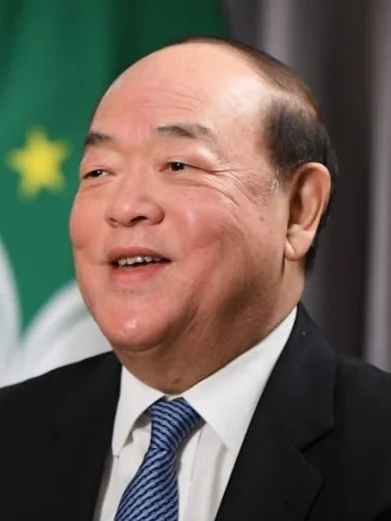
Ho Iat Seng: the industrial heir who led Macao through COVID and gaming reform
The 5th Chief Executive of the Macao SAR (2019-2024). From the Ho Tin Industrial family, he moved through business associations, the NPC Standing Committee, and the presidency of the Legislative Assembly before leading Macao through COVID-19, the gaming-concession reset, Hengqin integration, and post-pandemic recovery.
Ho Iat Seng賀一誠
5th Chief Executive of the Macao SAR · Government of the Macao SAR1957-Published Jan 1, 2026
The 5th Chief Executive of the Macao SAR (2019-2024). From the Ho Tin Industrial family, he moved through business associations, the NPC Standing Committee, and the presidency of the Legislative Assembly before leading Macao through COVID-19, the gaming-concession reset, Hengqin integration, and post-pandemic recovery.
He did not arrive at Government Headquarters out of nowhere. Ho Iat Seng's public identity was built step by step through Macao's industrial families, business associations, national institutions, and the president's chair of the Legislative Assembly.
Ho Iat Seng was the 5th Chief Executive of the Macao SAR (2019-2024). His path is especially revealing for Macao: first an industrial and business-association figure, then a long-serving deputy and standing committee member at the National People's Congress, then President of the Legislative Assembly, and finally Chief Executive. That trajectory gave him a reputation for pragmatism, steadiness, institutional discipline, and a business-aware understanding of public administration.
Profile
Chinese Name: 賀一誠
English Name: Ho Iat Seng
Born: 12 June 1957, Macao
Ancestral origin: Yiwu, Zhejiang
Region: Macao
Domains: Politics · Business
Industry: Public administration · Industrial manufacturing · Business associations
Subject type: Official
Personal Background
Ho was born in Macao into a family with roots in Zhejiang. His father, Ho Tin, founded Ho Tin Industrial in the 1950s and has often been described in Chinese-language coverage as an important figure in Macao's modern industrial history. Ho Iat Seng graduated from Pui Tou Middle School and later studied mechanical-electrical engineering and economics at Zhejiang University. Before becoming a full-time political figure, he worked in Ho Tin Industrial and related investment activities.
That background matters. Macao's public life has long been shaped by chambers of commerce, associations, and sector representatives. Ho did not enter public affairs as a campaign politician. He moved through business representation, national deliberative institutions, local executive consultation, and then the legislature. This helps explain the vocabulary that followed him into government: stability, coordination, reform, innovation, and moderate economic diversification.
Public Career
I. From business circles to national institutions
In 2000, Ho became a Macao deputy to the National People's Congress. In 2001, he joined the NPC Standing Committee, a role he retained until 2019, when he stepped down before running for Chief Executive. Across nearly two decades at the national level, he was not only a business representative from Macao but also a participant in the wider policy and constitutional context surrounding the SAR.
Share
Locally, he served as a member of the Executive Council from 2004 to 2009. The Executive Council advises the Chief Executive on major decisions, so by the time Ho entered the Legislative Assembly, he already had experience inside the SAR's institutional machinery.
II. Vice-President and President of the Legislative Assembly
Ho entered the Legislative Assembly in 2009 through the industrial, commercial, and financial functional constituency and became Vice-President. On 16 October 2013, he was elected President of the Legislative Assembly and was re-elected in 2017. He resigned on 5 July 2019 to prepare for the Chief Executive election.
The president's role is not merely ceremonial. The president represents the legislature, coordinates its work, and manages the institution's relationship with the executive branch. For Ho, those six years were a transition from business representative to institutional manager, with exposure to legislative procedure, budget scrutiny, government accountability, and the competing interests of Macao society.
III. The 2019 Chief Executive election
In 2019, Ho resigned from his NPC and Legislative Assembly roles to run in the fifth Chief Executive election. On 25 August 2019 he won 392 votes, described by the Macao SAR Government as 98 percent of the total votes available. The State Council later appointed him as Macao's 5th Chief Executive, and he took office on 20 December 2019.
His inaugural address set out "Unity and Effort, Change and Innovation" as the governing idea of the fifth-term government. The phrase is a useful key to his style: not a dramatic rupture, but a push for stronger administrative coordination and reform within the existing institutional and national policy framework.
Defining Governance Moments
I. COVID-19: stability under pressure
Soon after Ho took office, Macao faced COVID-19. For a city built around tourism, gaming, hotels, and retail, the pandemic was not only a public-health emergency; it was a direct stress test of the whole revenue model, job market, and small-business ecosystem.
The June 2022 outbreak was one of the most severe governance moments of his term. The government launched mass nucleic-acid testing, risk-zone controls, and a period of relative shutdown for non-essential activity. These measures placed heavy pressure on residents and businesses, but the official objective was to cut transmission quickly, preserve Macao's links with the mainland, and keep the city's basic systems operating. Ho repeatedly framed public health, daily supplies, and social stability as linked responsibilities.
This period shaped how he is remembered. Supporters point to the maintenance of medical and social order under uncertainty. Critics and affected businesses point to the economic cost of restrictions. To understand Ho's leadership, both sides matter: Macao, as a highly visitor-dependent city, had very few easy choices during the pandemic.
II. Gaming concessions: keeping six operators, changing the terms
The most structurally important policy of Ho's term was the 2022 public tender for Macao's gaming concessions. Under Executive Order No. 136/2022, the government opened a tender for six concessions with a maximum duration of ten years. MGM Grand Paradise, Galaxy Casino, Venetian Macau, Melco Resorts, Wynn Resorts Macau, and SJM Resorts were ultimately awarded concessions.
This was not simply a renewal. It placed the next decade of Macao gaming inside a tighter public-policy framework: foreign tourist markets, non-gaming investment, corporate social responsibility, stronger compliance, and prevention of illegal activity. For Macao, it marked a shift from relying on gaming revenue alone toward requiring gaming operators to participate more explicitly in the city's diversification.
III. Hengqin and "1+4": making diversification spatial and industrial
During Ho's term, the Guangdong-Macao In-depth Cooperation Zone in Hengqin became a major platform for Macao's moderate economic diversification. As Chief Executive, Ho also served as the Macao-side director of the zone's Administrative Committee, working with Guangdong counterparts on institutional alignment, industry development, livelihood integration, and cross-boundary infrastructure.
After the pandemic, the fifth-term government also advanced the "1+4" diversification strategy: keeping integrated tourism and leisure as the core while developing big health, modern finance, high technology, conventions and trade, culture, and sports. This could not be completed within one term, but it made Macao's long-discussed diversification agenda more concrete in industrial and spatial terms.
IV. One term only: health, transition, and political timing
On 21 August 2024, Ho announced that he would not participate in the election for the sixth-term Chief Executive, saying his health had not fully recovered and that the decision was made for Macao's long-term development and the overall situation. This made him the first Macao Chief Executive after the handover not to seek re-election. Sam Hou Fai, then President of the Court of Final Appeal, later ran and was elected as the sixth Chief Executive, with Ho's government completing the transition.
The decision gave Ho's term a clear historical boundary: he entered office at the 20th anniversary of Macao's return to China and left office at the 25th, with the five years between defined by the pandemic, the gaming reset, and the first stage of post-pandemic recovery.
Public Character
Ho's strength was institutional familiarity. He understood Macao's business circles, national governance channels, and local public administration. His political language was not theatrical; it sounded more like an administrator's language: procedure, coordination, stability, and problem management. In personal-brand terms, his public image is less "charismatic leader" and more "system-literate operator who can hold the line."
His term also left unresolved work. The economic pain of COVID-19 required time to repair, non-gaming sectors remained early-stage, and Hengqin-Macao integration still needed cross-administration follow-through. But in Macao's development story, Ho's role is one of transition: carrying forward the institutional results of the post-handover gaming-growth era while pushing Macao into a phase of stronger regulation, heavier diversification expectations, and deeper regional coordination.
Key Achievements
Built a rare cross-sector career across Macao business circles, national institutions, the legislature, and the executive branch
Served six years as President of the Legislative Assembly, leading the institution through key sessions of the fifth and sixth legislatures
Won the 2019 Chief Executive election with 392 votes and introduced "Unity and Effort, Change and Innovation" as the fifth-term government's governing idea
Completed the 2022 public tender for gaming concessions, setting new conditions for the industry's next decade
Advanced the Hengqin cooperation zone and the "1+4" direction for moderate economic diversification
Led the fifth-term government through COVID-19 and the first stage of recovery
Received Macao honours including the Medal of Merit for Industry and Commerce, the Golden Lotus Medal of Honour, and the Grand Lotus Medal of Honour in the 2025 honours list