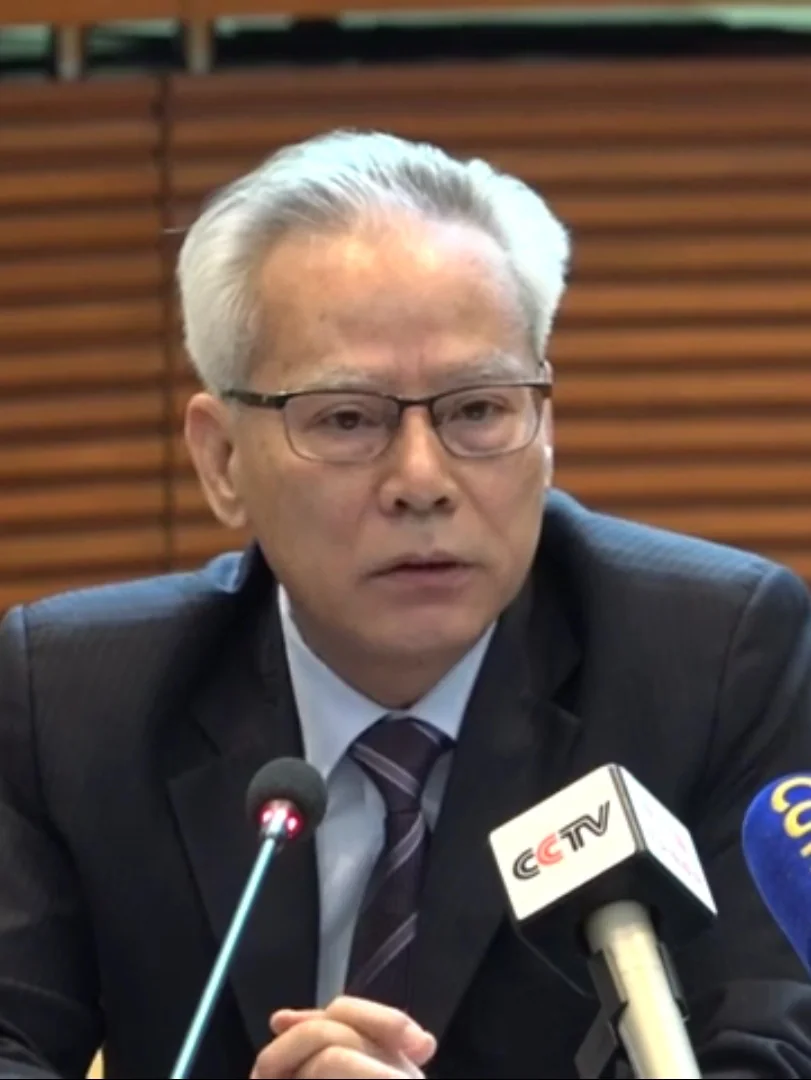
Sam Hou Fai: the first jurist to walk from Macao's top court into Government House
The 6th Chief Executive of the Macao SAR, sworn in by President Xi Jinping on 20 December 2024. Born to a farming family in Zhongshan, Guangdong; trained at Peking University Law and the University of Coimbra; first President of Macao's Court of Final Appeal for almost twenty-five years from 1999, where he presided over the Ao Man Long and Ho Chio Meng corruption trials. The first Macao Chief Executive drawn from the judiciary, he has anchored his first term in rule of law, public-administration reform, and economic diversification.
Sam Hou Fai岑浩輝
6th Chief Executive of the Macao SAR · Government of the Macao SAR1962-Published Jan 1, 2026
The 6th Chief Executive of the Macao SAR, sworn in by President Xi Jinping on 20 December 2024. Born to a farming family in Zhongshan, Guangdong; trained at Peking University Law and the University of Coimbra; first President of Macao's Court of Final Appeal for almost twenty-five years from 1999, where he presided over the Ao Man Long and Ho Chio Meng corruption trials. The first Macao Chief Executive drawn from the judiciary, he has anchored his first term in rule of law, public-administration reform, and economic diversification.
From the rulings of the Court of Final Appeal to the inaugural address at Government House — a jurist trained in Beijing, Coimbra and Macao has taken the SAR's highest administrative seat.
Sam Hou Fai is the 6th Chief Executive of the Macao SAR, sworn in by President Xi Jinping on 20 December 2024. Before that, he served almost twenty-five consecutive years as the first President of the Court of Final Appeal, beginning the day the SAR was established. He is the first Macao Chief Executive drawn from the judiciary — and the first since the Handover not drawn from the city's business families. His selection is widely read as a deliberate central wager on "rule of law" and "administrative reform" as the two organising themes of Macao's next political cycle.
Inauguration: 20 December 2024 (25th anniversary of Macao's Handover)
Background
Sam was born in May 1962 to a farming family in Heping Village, Dongfeng Commune, Zhongshan County, Guangdong — the same Pearl River Delta region from which generations of Macao migrants had come. He entered primary school late, at nine, but by 1978 had won admission to Zhongshan Memorial Middle School, and in 1981 placed first in Zhongshan's humanities track in the gaokao, earning a seat at Peking University Law — China's most selective legal programme in the early reform era. After graduation he joined the Guangzhou Foreign Economic Law Firm, the country's first specialised foreign-economic-affairs practice, founded in 1984.
In November 1986 he moved to (still Portuguese) Macao. The Sino-Portuguese Joint Declaration had just set 1999 as the handover year, and the territory faced an acute shortage of legal personnel fluent in both Chinese and Portuguese. In 1990, Sam passed Macao's first public examination for legal talent and was sent to the University of Coimbra for three years to study Portuguese language, culture and law, returning to Macao in 1993. Macao commentators count him among the "Thirteen Apostles" (十三太保) — a cohort of mainland-trained jurists deliberately cultivated by Beijing to staff the post-handover judiciary, alongside contemporaries such as Cheong Weng Chon and Wong Sio Chak.
His wife — whose identity is not publicly disclosed — and their two children have lived in Macao throughout his career; Sam has emphasised that "three generations of my family have lived here." His 2024 asset declaration lists four jointly-held properties (one in Coloane, three in Guangdong) and no corporate shareholdings, a deliberate contrast with his three business-dynasty predecessors.
Career
I. From mainland law to Macao's judicial localisation (1981–1999)
Sam's judicial career runs almost in lockstep with the localisation of Macao's judiciary under "one country, two systems." Admission to Peking University Law in 1981, a move to Macao in 1986, the 1990 Coimbra scholarship, return to Macao in 1993, the first cohort of judicial auditors in 1994, and the first magistrate-training course in 1995 — the arc is, in miniature, the story of how Macao's Portuguese-led pre-handover bench was handed over to ethnic-Chinese magistrates trained in both legal traditions. In 1997 he became a judge of the Court of General Jurisdiction and was elected to the Judiciary Committee.
II. First President of the Court of Final Appeal (1999–2024)
On 20 December 1999, the day the Macao SAR was established, Sam — then thirty-seven — was appointed by the first Chief Executive, Edmund Ho Hau Wah, as the first President of the Court of Final Appeal. He led twenty-three SAR judges in taking the oath in Putonghua and Portuguese. For the next twenty-four years and eight months he held that role, concurrently chairing the Council of Judicial Magistrates, sitting on the Independent Commission for the Recommendation of Judges and the Working Committee on Regional and International Mutual Legal Assistance, and serving as honorary president of the Association for the Promotion of the Macao Basic Law. He was, in practice, the longest-serving anchor of the SAR's judicial architecture.
As CFA president he sat as presiding judge in the most consequential corruption trials of the post-handover era. In the Ao Man Long case (2007–2008) he sentenced the former Secretary for Transport and Public Works to 27 years and a MOP 240,000 fine, calling the conduct "insatiably greedy" and "shocking." Two further sentencing rounds in 2009 and 2012 brought Ao's total prison term to 29 years and led the SAR Government to void the contested "Pearl Horizon" land grants. In 2016–2017 he presided over the trial of Ho Chio Meng, Macao's first Prosecutor-General — almost 1,970 charges, a single 21-year sentence, and a denied recusal request despite the two having been classmates in Portugal. Sam later described the case as "a wonder under heaven" and treated both trials as a stress test of how the rule of law would respond when the state itself was on the wrong side of the dock.
His record also contains genuinely contested moments. In 2021, sitting as a panel judge of the CFA, he joined two rulings with sharp political stakes: dismissing the appeal by the Macao Democratic Development Union Committee over the banning of the June 4 vigil, and upholding the Electoral Affairs Commission's disqualification of three pro-democracy electoral lists from that year's Legislative Assembly election. Critics argued both decisions narrowed civil rights; supporters saw them as drawing red lines that "one country, two systems" requires. Reporters who covered his trials describe his courtroom manner as comparatively even-handed — willing to give both prosecution and defence space, but quick to cut off testimony that wandered toward serving officials. In his own words, judicial officers must be "sparing in speech" and stay out of "political activity"; he distilled his ethic of office in four-character maxims: 心靜平和 (a calm and steady mind), 敬畏權力 (a healthy fear of power), and 嚴以修身、嚴以用權、嚴以律己 (strict in self-cultivation, in the use of power, and in self-discipline).
On 26 August 2024 Chief Executive Ho Iat Seng signed an executive order accepting Sam's resignation, effective 28 August; 27 August 2024 was his last day in office. His tenure of 24 years and 8 months remains the longest of any post-Handover judicial head.
III. Election and inauguration as Chief Executive (2024–present)
Sam announced his candidacy at the Macao Science Centre on 28 August 2024 — the first contender of the SAR era not drawn from the business establishment. On 18 September the Electoral Affairs Commission, following vetting by the Committee for Safeguarding National Security, confirmed him as the sole accepted candidate; he had been nominated by 386 of the 400 members of the Election Committee. Ten days later he laid out a three-hour platform — stricter gaming regulation, public industrial funds, deeper coordination with Hengqin, and an explicit commitment to protect the Portuguese-descended community's customs and rights — before substantially the full Election Committee.
The 13 October poll, a foregone conclusion, returned him with 394 valid ballots out of 398 cast — 98.99% of the available 400-seat committee, with four blank ballots and two members absent. State Council Decree No. 794, presented by Premier Li Qiang in the presence of President Xi Jinping, formally appointed him on 25 October. On 30 November the State Council, acting on Sam's nominations, named his principal officials: Cheong Weng Chon (Administration and Justice), Tai Kin Ip (Economy and Finance), Wong Sio Chak (Security, retained for a third term), O Lam (Social Affairs and Culture) and Tam Vai Man (Transport and Public Works), alongside Prosecutor-General Chan Tsz King. The slate — all career civil servants, several holdovers — was framed by Beijing and local media as a deliberate emphasis on "continuity and expertise."
Sam was sworn in by President Xi at the Macao East Asian Games Dome on 20 December 2024, the 25th anniversary of the Handover. Before some 1,300 guests he set the motto of his government — "Striving Together, Upholding Integrity and Innovating" — and adopted Xi's "Three Aspirations" and "Four Expectations" as the central axis of his term, projecting a long-range vision of a "Law-based, Vibrant, Cultural and Blissful Macao."
Defining Moments
1. A cabinet that bought time with continuity (Nov–Dec 2024)
Between his nomination and inauguration, Sam set out five public criteria for his principal officials — patriotism and loyalty to Macao, a strong sense of national security, public-welfare orientation, courage and accountability, and team spirit — and built his nominations accordingly. The slate the State Council confirmed on 30 November was uniformly drawn from the career civil service: "security tsar" Wong Sio Chak retained for a third term, Cheong Weng Chon kept as the number-two Secretary for Administration and Justice, alongside Tai Kin Ip, O Lam, Tam Vai Man, and Prosecutor-General Chan Tsz King. Commentators read it as a deliberate "continuity-and-expertise" trade — picking insiders who knew the machinery in exchange for early bandwidth on reform.
2. Five leading groups and the opening salvo of administrative reform (from Feb 2025)
On 13 February 2025, by internal directive, Sam created five cross-departmental leading and working groups and personally chaired two of them — the Leading Group on Public Administration Reform and the Leading Group for the Hengqin Cooperation Zone — concentrating cross-portfolio coordination in the Chief Executive's office to an extent unprecedented since the Handover. The reform agenda that followed produced departmental mergers and a new general regime for the establishment and organisational structure of public bodies. During his 19 November 2025 legislative Q&A he repeatedly insisted the reform was "not about layoffs, downgrades or pay cuts," set a 2029 deadline for publishing a roadmap, and framed it as enhancing civil servants' "social standing and dignity."
3. The first Policy Address — and the fiscal subtext (14 April 2025)
Sam delivered his first Policy Address in the Legislative Assembly on 14 April 2025, under the title "Innovate to elevate; forge ahead to break new ground", structured around four directions — accelerating diversification, improving livelihoods, raising governance capacity, and integrating into national development. Headline measures included a government industrial fund, a review group for business regulations, R&D on a "Digital Macao Pataca," revitalisation of the old town and an interest-subsidy scheme for SME bank loans. At under fifty pages, it was deliberately compressed; Sam explained that the remaining fiscal year was short and that the 2026 address would arrive in November. Local analysts read between the lines: the document acknowledged tensions between Beijing-assigned tasks and local interests, and indirectly exposed a forecast 2025 budget surplus of only about MOP 7.7 billion — pressure that Sam himself flagged in rare public remarks about the risk of a deficit if gaming revenue underperformed.
4. First duty visit to Beijing — and the central verdict on year one (December 2025)
Sam made his first duty visit to Beijing as Chief Executive on 15–17 December 2025, with Wong Sio Chak acting in his place in Macao. At Zhongnanhai on 16 December, in the presence of Premier Li Qiang and HKMAO Director Xia Baolong, President Xi heard his report and gave the SAR government's first year his "full recognition" — singling out an "enterprising and pragmatic" tone, firm defence of sovereignty and security, the orderly conduct of the Eighth Legislative Assembly election, the public-administration reform programme, and contributions to the Greater Bay Area. Returning to Macao the next day, Sam declined to grade himself, telling reporters that "the most authoritative voice on my work is in fact the 680,000 residents of Macao," and condensed his 2026 priorities to two propositions handed down from Xi: accelerating economic diversification and raising governance capacity.
Public Character
Public coverage of Sam clusters around the same keywords: jurist, low-profile, technocratic, not from business. SCMP describes him as having "no vested interest in casinos" — an outsider to Macao's traditional gaming families. Political scientist Sonny Lo notes that "his judicial track record in Macao, mainland China and Portugal makes the 66 nomination votes easy work." Local reporters who covered his trials describe him as "comparatively even-handed in court, not biased toward prosecutors" but "quick to cut off testimony that drifts toward sitting officials."
At the one-year mark, the Macao and Portuguese-language press split into two camps. Favourable assessments stressed proactive economic diversification (UM economist Henry Lei), a 4.1% YoY rise in social-welfare spending (legislator Leong Hong Sai), and willingness to "take unconventional measures" — economist Sales Marques cited Cheong Weng Chon's pivot to the Legislative Assembly presidency as an example. Reserved assessments emphasised that this was "a year of transition, with results not yet visible" (Hoje Macau / Casa de Portugal head Amélia António) and that a year without a working talent-attraction scheme had cost the SAR international credibility (European Chamber of Commerce VP Rui Pedro Cunha).
At the central level, Xi Jinping's December 2025 verdict — "enterprising and pragmatic", with the Legislative Assembly election, administrative reform and Greater Bay Area integration named as flagship accomplishments — has become the political coordinate around which Sam's second Policy Address and 2026 agenda are organised.
Key Achievements
6th Chief Executive of the Macao SAR, sworn in by President Xi Jinping on 20 December 2024 after winning 394 of 398 valid ballots as the sole candidate
Longest-serving President of the Court of Final Appeal, 20 December 1999 to 27 August 2024 — almost twenty-five years; presiding judge in the Ao Man Long and Ho Chio Meng corruption trials, the largest in post-Handover history
First Macao Chief Executive drawn from the judiciary — and the first SAR-era CE not drawn from the business establishment
Delivered his first Policy Address "Innovate to elevate; forge ahead to break new ground" (April 2025) and second Policy Address "Reform with firmness, elevate efficiency, unite to break through and promote diversification" (November 2025)
From 2025, personally chairs the Leading Group on Public Administration Reform and the Leading Group for the Hengqin Cooperation Zone — driving the largest public-sector reorganisation since the Handover
December 2025: first duty visit to Beijing as CE; received Xi Jinping's "full recognition" of the SAR government's first year
Information compiled from gov.mo, Xinhua, China Daily, court.gov.mo, BBC News Chinese, AAMacao, SCMP, Hong Kong Commercial Daily and other publicly available sources. If anything is inaccurate or needs updating, please contact us — we aim to respond within 48 hours.