
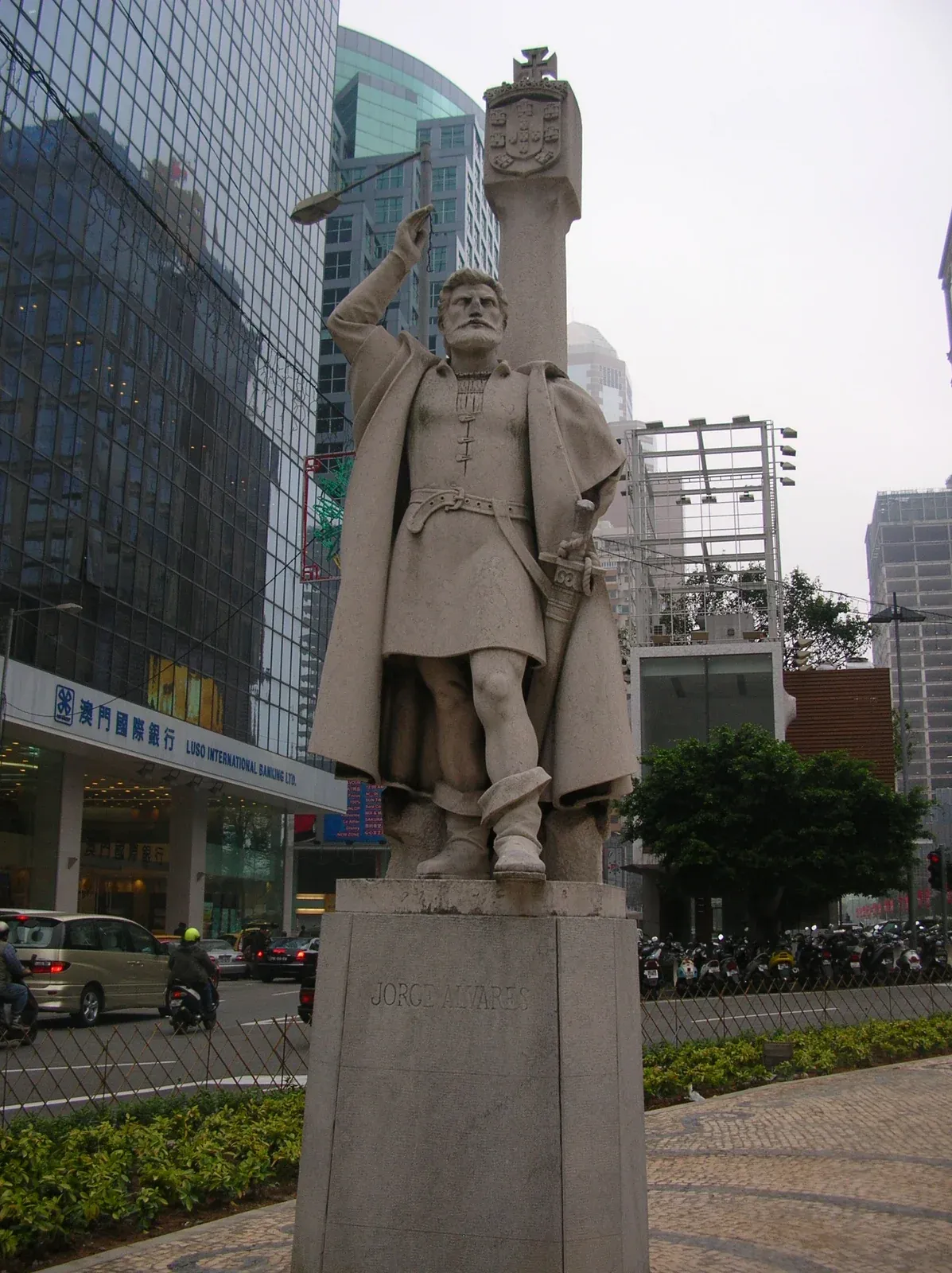
A Portuguese navigator who reached the Pearl River estuary in 1513 and is regarded as among the first Portuguese to arrive in China by sea. He died near Tuen Mun on 8 July 1521. The Macau square 歐華利前地 (also rendered 區華利前地) carries his name.
A navigator who brought Portuguese sails to the Pearl River estuary in 1513; five centuries on, Macau remembers his blurred but pivotal figure through a square and a statue.
Jorge Álvares was a Portuguese navigator regarded as among the first Portuguese to reach China by sea. The Macau square Praça de Jorge Álvares is named after him.
Profile
- Chinese Name: 歐華利 (also rendered 區華利)
- Portuguese Name: Jorge Álvares
- Born: late fifteenth century (year unknown)
- Died: 8 July 1521 (near Tuen Mun)
- Region: Portugal / Pearl River estuary · Tuen Mun
- Domains: Politics · Navigation
- Subject type: Historical figure · Navigator
Background
Little survives of Álvares's early life, and his birth year is unknown. He was active in the early-sixteenth-century wave of Portuguese eastward expansion, among the pioneers of the Age of Discovery who reached the Far East.
Career
I. Reaching the China coast (1513)
In 1513 Álvares sailed to the Pearl River estuary (then called Tamão / 屯門) and is regarded as among the first Portuguese to reach China by sea. He traded there and erected a Portuguese stone marker (padrão) at the site.
II. Death and burial (1521)
Álvares died near Tuen Mun on 8 July 1521. By accounts, he was buried — at his own wish — beside the stone marker he had set up, considered one of the earliest Portuguese markers on the China coast.
Defining Moments
I. A blurred pioneer
Álvares is a hazy figure in the record: his likeness is later guesswork, and the exact sites of his landing and trade remain debated. This archive presents the account neutrally and distinguishes carefully between what is documented and what is conjecture.
II. The Macau naming and statue
Praça de Jorge Álvares in Macau is named after him, and a statue of him (by the sculptor Euclides Vaz, unveiled in 1954) stands nearby. The Chinese rendering used in Macau is 歐華利; some Taiwanese media use 區華利.
Public Character
Álvares was among the pioneers of the Portuguese Age of Discovery to reach the China coast, his historical significance outweighing the certainty of his biographical detail. This archive offers no praise or blame and notes that his link to Macau belongs to the wider arc of maritime history.