
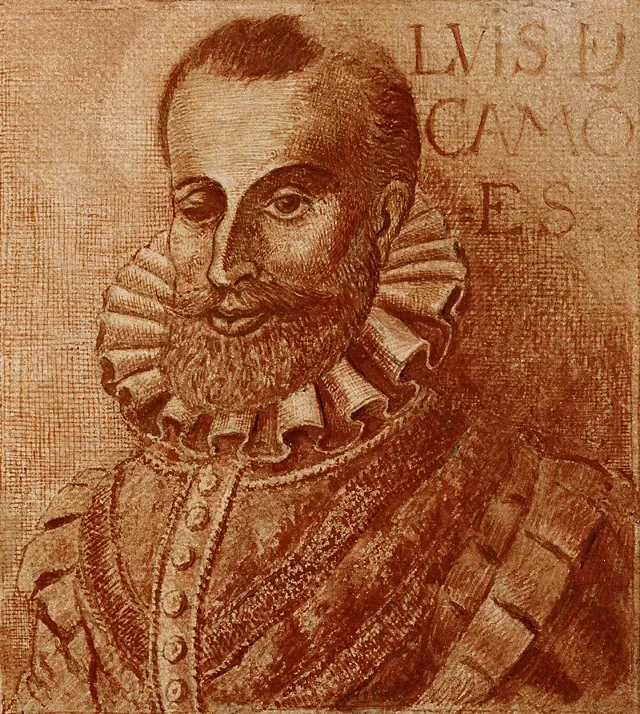
Portugal's national poet and author of the epic Os Lusíadas (rendered in Macau as 葡國魂), regarded as a founding figure of Portuguese-language literature. Camões Garden in Macau is named after him; the well-loved story that he composed part of the epic in a grotto there is a legend, not documented fact.
A national poet who turned a people's seafaring memory into epic verse — and whom Macau keeps alive through a garden, a grotto, and a legend.
Luís de Camões was Portugal's national poet and the author of the epic Os Lusíadas. Camões Garden in Macau bears his name, linking the city to the most important name in Portuguese-language literature.
Profile
- Chinese Name: 賈梅士
- Portuguese Name: Luís Vaz de Camões
- Born: c. 1524
- Died: 10 June 1580
- Region: Portugal / Macau (by tradition)
- Domains: Culture · Literature
- Subject type: Cultural figure · Poet
Background
Born around 1524, Camões had a sparsely documented early life. His was a turbulent existence — he served as a soldier and travelled through Portugal's overseas territories. His work fused the classical epic tradition with Portugal's seafaring experience, making him a founding figure of Portuguese-language literature.
Career
I. Writing Os Lusíadas
Camões's masterwork, Os Lusíadas (rendered in Macau as 葡國魂), takes the voyage of the navigator Vasco da Gama as its narrative spine and celebrates the nation's maritime history. By accounts it was written largely between 1550 and 1570 and first published in Lisbon in 1572, becoming a classic of Portuguese-language letters.
II. The Macau connection (by tradition, c. 1556)
Accounts place Camões in Macau around 1556, where he is said to have held a post. This period of his life was later associated with the grotto in what is now Camões Garden.
Defining Moments
I. The legend of the Camões Grotto
Tradition holds that Camões composed part of Os Lusíadas in the grotto of present-day Camões Garden. The story is widely told but is legend rather than documented fact. This archive marks it clearly as legend, not history.
II. Camões Garden and commemoration
The garden and grotto are a Macau landmark, and a bust of the poet stands in the park. Each year on 10 June — the anniversary of his death and Portugal's national day — Macau's Portuguese-speaking community lays flowers at the grotto and recites his verse, keeping the legend part of the city's cultural memory.