
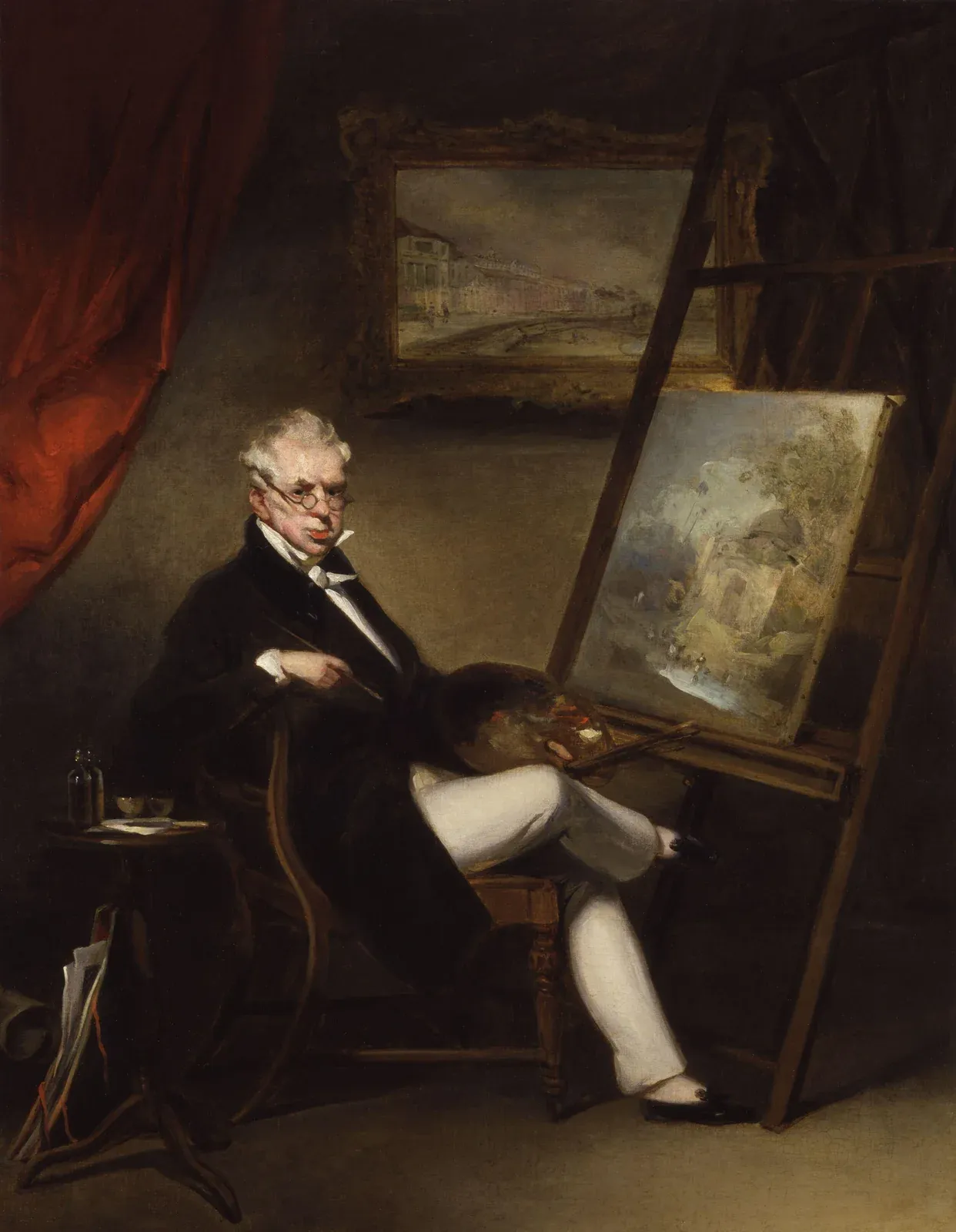
An English painter, born in London in 1774, who spent years in Madras and Calcutta before settling in Macau in 1825, where he lived until his death in 1852. He was the only Western painter resident in South China through the early-to-mid 19th century, recording Macau's streets, temples and the ordinary people of the Pearl River Delta in oils, watercolours and drawings. He is buried in Macau's Old Protestant Cemetery.
A painter who fled London and his debts to the far edge of the world — and found in Macau the subject of his life, drawing the city and the everyday Pearl River into history.
George Chinnery was an English painter who spent his final twenty-seven years in Macau. In oils, watercolours and drawings he gave a face to nineteenth-century Macau and the Pearl River Delta, leaving a visual archive without which the old city cannot be understood today.
Profile
- Chinese Name: 錢納利
- English Name: George Chinnery
- Born: 5 January 1774 (London)
- Died: 30 May 1852 (Macau)
- Region: London / Madras / Calcutta / Macau
- Domains: Culture · Painting
- Subject type: Cultural figure · Painter
Background
Chinnery was born in London in 1774 and trained at the Royal Academy Schools, working early on in Ireland. In 1802 he sailed for Madras and then Calcutta, becoming the most sought-after portrait and landscape painter of the British community in India. Persistent financial trouble and mounting debt eventually pushed him to leave India for southern China in 1825.
Career
I. Settling in Macau (1825)
Chinnery based himself in Macau from 1825. For a painter used to the colonial high society of British India, the Portuguese architecture, cobbled lanes and Chinese temples of Macau were an entirely new subject. He barely left South China again, becoming the only Western painter resident there during this period.
II. Chronicler of Macau and the Pearl River
In oils, watercolours and a vast body of sketches, Chinnery recorded Macau's streets, churches, temples and ordinary people — the Ruins of St Paul's, the Holy House of Mercy, St Dominic's Church, the A-Ma Temple, and the fishermen, hawkers and boat people of the Pearl River Delta. Because he was the sole resident Western artist of the time, these works are a precious historical record of Macau as it looked before extensive land reclamation reshaped the territory.
Defining Moments
I. Influence on Cantonese export painting
Chinnery's handling of oil paint was closely imitated by the Cantonese painter Lam Qua, who became a celebrated portraitist and carried a Western realist manner into the Cantonese export-painting tradition — extending Chinnery's influence across a far wider South China art world.