
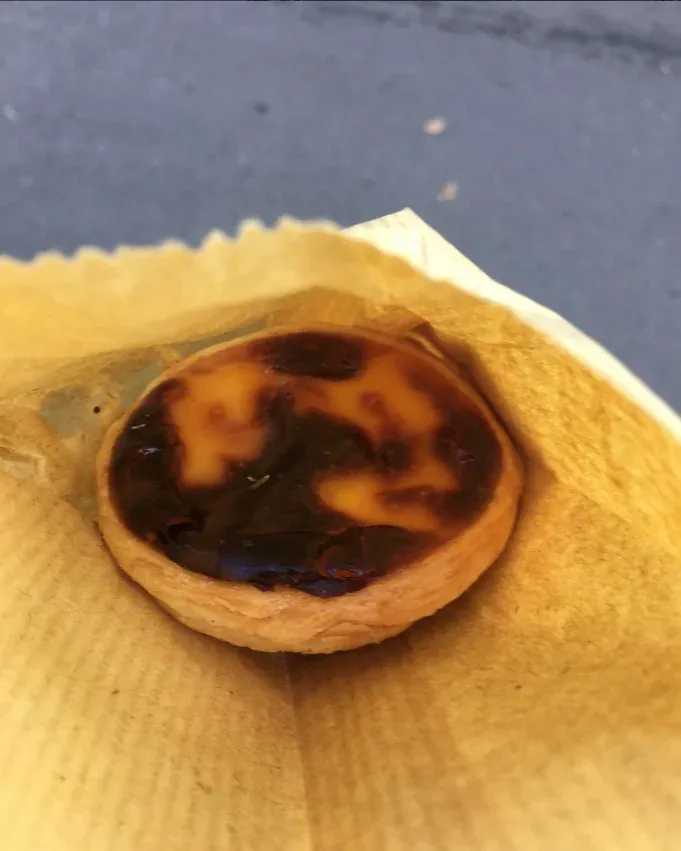
The British pharmacist who created Macau's Portuguese egg tart. He moved to Macau in 1979 and in 1989 opened Lord Stow's Bakery in Coloane village, adapting Portugal's pastéis de nata into a creamier, caramel-topped "Macau egg tart" — making the tart one of the city's most iconic tastes.
A British pharmacist used a laboratory's spirit of experiment to rewrite Portugal's egg tart as a taste of Macau.
Andrew Stow created Macau's Portuguese egg tart. In 1989 he opened Lord Stow's Bakery in Coloane village, adapting Portugal's pastéis de nata into the "Macau egg tart" — making it one of the city's most iconic tastes.
Profile
- Chinese Name: 安德魯·史斗
- English Name: Andrew Stow
- Born: c. 1955 (Essex, England)
- Died: 2006 (Macau)
- Domains: Business · Everyday
- Industry: Bakery · Food & drink
- Subject type: Entrepreneur · Founder
Background
Andrew Stow was born around 1955 in Essex, England, and trained as an industrial pharmacist, working for the chemist chain Boots. In 1979 he moved to Macau to work for a pharmaceutical company. He had no baking training — yet in this small city where Chinese and Portuguese worlds meet, he found the most unexpected career of his life.
Career
I. From pharmacist to baker
In the 1980s, on a trip to Portugal, Andrew tasted pastéis de nata (Portuguese custard tarts). With no recipe to hand, he used a pharmacist's instinct for trial and error — pairing Portuguese pastry with a richer British-style custard, cutting the cinnamon and adding cream — to produce a smoother version suited to local tastes. In September 1989 he and his then-wife opened Lord Stow's Bakery in Coloane village, and the signature "po tat" (Portuguese egg tart) was born.
II. Turning a tart into a symbol of Macau
From 1997, franchising of the tart set off an Asia-wide craze. Lord Stow's grew from a single Coloane shop into several outlets, baking egg tarts by the tens of thousands daily and expanding to Japan, South Korea, the Philippines and Hong Kong. In January 2006 he received the Macau SAR Government's Tourism Merit Medal; the craft of making the Macanese egg tart was added to Macao's intangible cultural heritage inventory in 2020.
Defining Moment
An Englishman who wrote a taste of Macau
What makes Andrew Stow's story remarkable is that a snack now seen as quintessentially "Macau" in fact began with a British pharmacist's adaptation of a Portuguese dessert. It is a miniature of Macau's character as a crossroads of Chinese, Portuguese and English influences: a foreign recipe that took root in the small city and grew into a taste all its own.