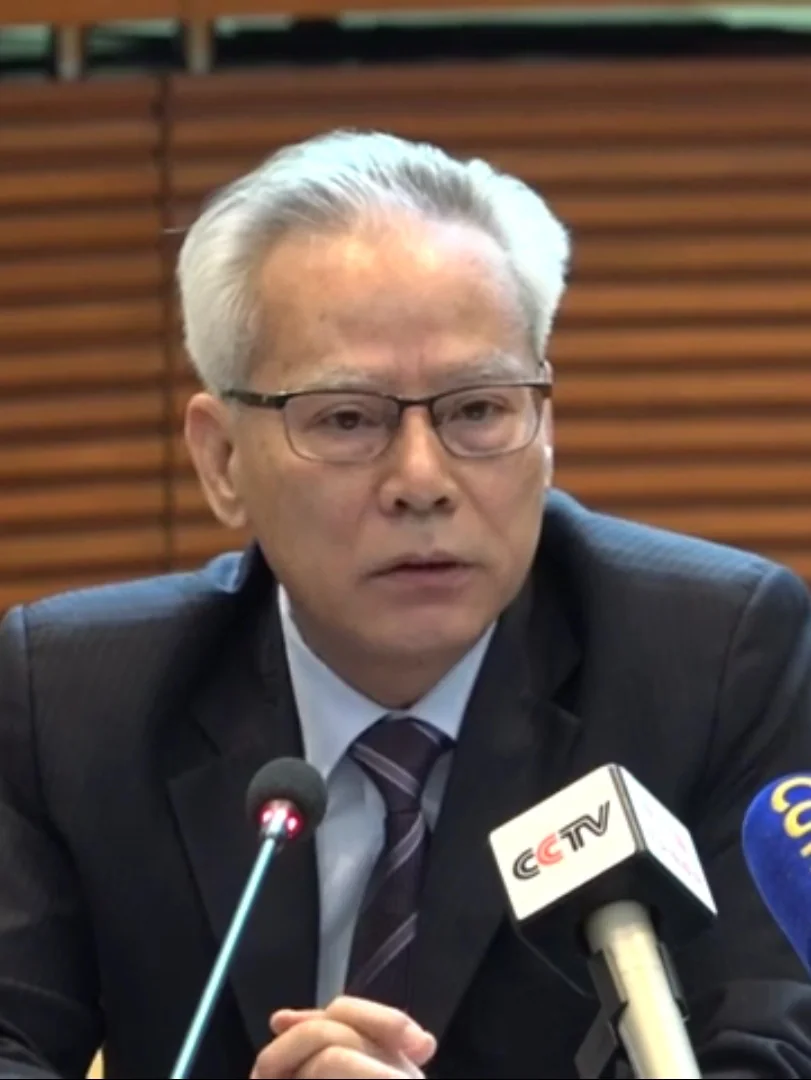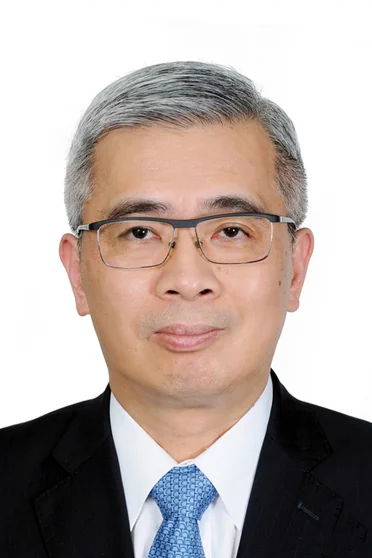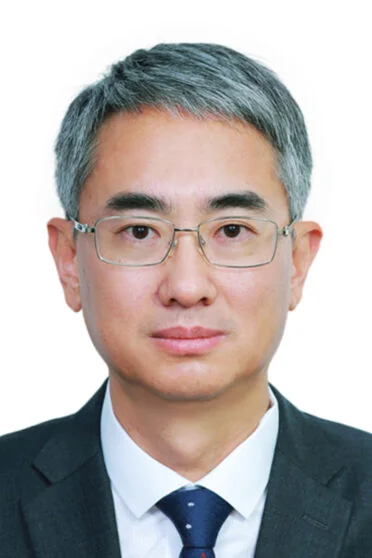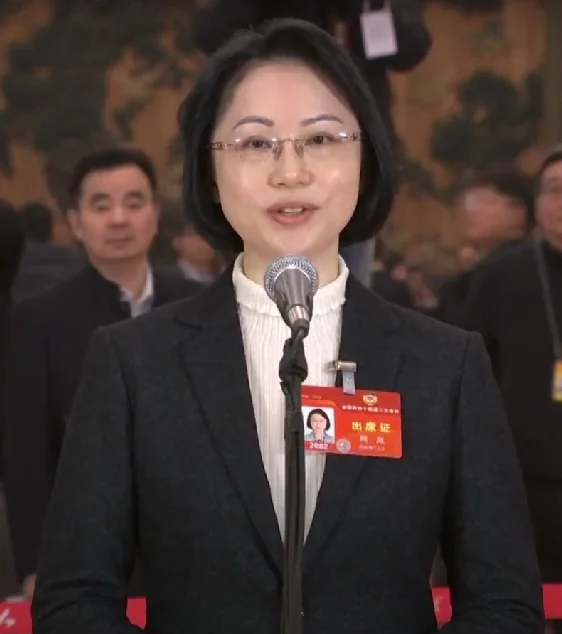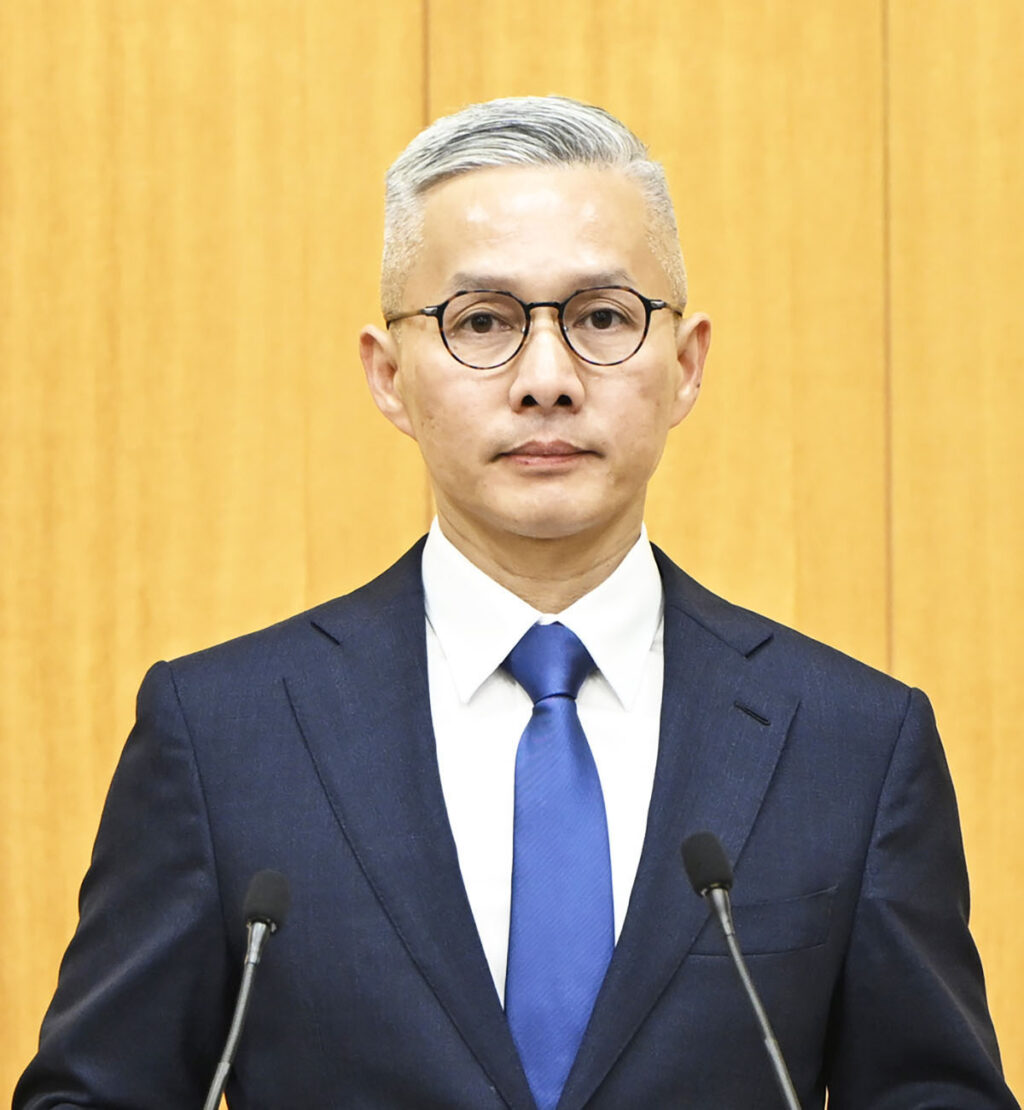
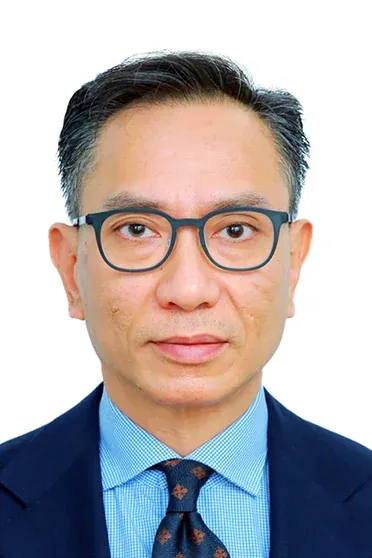
Secretary for Security of the Macao SAR since 16 October 2025, succeeding Wong Sio Chak (who moved to Administration and Justice) in Sam Hou Fai's mid-term reshuffle. Born in Hong Kong in 1970, he holds an LL.B. from the Autonomous University of Lisbon and graduated from Macao's first Magistrates Training Course in 1997. He spent almost 22 years in the Public Prosecutions Office — as prosecutor (from July 1997), Assistant Prosecutor-General (from March 2000), and posted to the Court of Final Appeal / Second Instance Court office (from January 2012). On 20 December 2019 he was appointed Commissioner Against Corruption (CCAC) for a 5-year statutory term; on 20 December 2024 Sam Hou Fai nominated him Prosecutor-General, a role he held for only 10 months. By State Council decree on 29 September 2025 he was elevated to Secretary for Security and sworn in on 16 October 2025; he oversees the Judiciary Police, the Public Security Police, Customs, the Fire Services Bureau, the Correctional Services Bureau, and the Macao Security Forces Higher School.
Twenty-two years in prosecution, five at the helm of the anti-corruption commission, ten months as Prosecutor-General, and now Secretary for Security — Chan Tsz King is the most technically trained legalist in Sam Hou Fai's mid-term reshuffle.
Chan Tsz King (陳子勁) is Secretary for Security of the Macao SAR (since 16 October 2025). Born in Hong Kong in 1970 and a Macao permanent resident, he holds an LL.B. from the Autonomous University of Lisbon and graduated from Macao's first Magistrates Training Course in 1997 — a trajectory that took him from prosecutor to Assistant Prosecutor-General, to Commissioner Against Corruption (2019–2024), to Prosecutor-General (December 2024 – October 2025), to Secretary for Security in the Sam Hou Fai mid-term reshuffle. He is the first former Prosecutor-General to move sideways into the Security portfolio in the post-Handover record.
Profile
- Chinese Name: 陳子勁
- English Name: Chan Tsz King
- Born: 1970 (Hong Kong)
- Macao status: Permanent resident
- Domains: Politics · Legal
- Industry: Prosecution · Anti-corruption · National security · Public administration
- Subject type: Official (Secretary for Security)
- Education: Studies at the Faculty of Arts and Humanities of the University of Lisbon (1989); LL.B. from the Autonomous University of Lisbon (1995); Macao's 1st Magistrates Training Course (1997); 1st Advanced Magistrate Training Course (1998)
- Sworn in (current role): 16 October 2025
Background
Chan was born in Hong Kong in 1970 and is a Macao permanent resident. He studied Portuguese at the Faculty of Arts and Humanities of the University of Lisbon in 1989 and earned an LL.B. from the Autonomous University of Lisbon in 1995 — one of a small cohort of 1990s Macao legal professionals to combine Hong Kong origin, Portuguese legal training, and Macao practice. He completed Macao's first Magistrates Training Course in 1997 — the inaugural cohort that produced several senior figures of today's SAR judiciary, with Chan as one of its representatives who later entered the prosecution service. The public record does not document his spouse or children; his working languages are Portuguese and Chinese.
His career foundation is the prosecution and anti-corruption apparatus — the two institutions most closely tied to Macao's rule-of-law, anti-graft and national-security policy lines, and the institutional credit on which Sam Hou Fai's direct nomination of him for Security in October 2025 rested.
Career
I. Prosecutor, Assistant Prosecutor-General, and Court of Final Appeal office (1997–2019)
Chan was appointed prosecutor at the Public Prosecutions Office in July 1997 after completing Macao's 1st Magistrates Training Course; in 1998 he concurrently lectured at the Faculty of Law of the University of Macau (until 2004). In March 2000 he was promoted to Assistant Prosecutor-General — at age 29–30, one of the youngest at the time. From January 2012 he was posted to the Court of Final Appeal / Court of Second Instance office, handling appellate-level prosecution work, while serving on the Prosecutors' Committee (from 2012), the Law Reform Council (from 2015), the Asset Freezing Coordination Commission (from 2017), and the 5th Chief Executive Electoral Affairs Commission (2019). Twenty-two years in prosecution built the legal-professional foundation and institutional credit that anchored his subsequent CCAC and Secretary-for-Security roles.
II. Commissioner Against Corruption (20 December 2019 – 19 December 2024)
On 20 December 2019 Chief Executive Ho Iat Seng appointed Chan Commissioner Against Corruption (CCAC) for the 5-year statutory term — the second Commissioner from a pure prosecution background after André Cheong. The most publicly documented work of his tenure includes the 2021 Legislative Assembly election integrity probe (he publicly disclosed three "highly suspicious" campaign-finance cases on 1 September 2021), the Kun Iam Statue project complaint (cleared, no administrative violations), and CCAC's 2023 Annual Report logging 249 cases including 102 corruption cases. His CCAC tenure also covered the political-vetting work tied to the 2021–2024 candidate disqualifications, the 2022 gaming-law overhaul, and the 2023 National Security Law amendments — a workstream that places him squarely in the legal-technocrat lineage of Sam Hou Fai, Wong Sio Chak and André Cheong.
III. Prosecutor-General (20 December 2024 – 15 October 2025)
On 30 November 2024 the State Council, on Chief Executive-elect Sam Hou Fai's nomination, appointed Chan Prosecutor-General of the Macao SAR; he was sworn in on 20 December 2024, succeeding Cheong Chong Cheng. His tenure ran only 10 months — among the shortest in the post-Handover record — and was dominated by two internationally watched cases: the April 2025 detention of two All About Macau (AAMacau) journalists (whose post-detention legal handling was referred to his office) and the 30 July 2025 arrest of former pro-democracy legislator Au Kam San (區錦新) under the National Security Law — Macao's first-ever arrest under the National Security Law since the Handover. Both cases were led by his Public Prosecutions Office, and both drew attention from the EU EEAS, Human Rights Watch, the Committee to Protect Journalists (CPJ), and Reporters Without Borders (RSF).
IV. Secretary for Security (16 October 2025–present)
On 29 September 2025 State Council Decree no. 808 announced Sam Hou Fai's mid-term reshuffle: André Cheong stepped down as Secretary for Administration and Justice to take a CE-appointed legislator seat (subsequently elected President of the Legislative Assembly); Wong Sio Chak moved to Administration and Justice; and Chan succeeded Wong as Secretary for Security, with Tong Hio Fong simultaneously appointed Prosecutor-General. Chan was sworn in by Sam on 16 October 2025, succeeding Wong after almost eleven years in the Security portfolio — the first former Prosecutor-General in the SAR's history to be moved sideways into Security. Ex officio under the Basic Law, he joined the Executive Council. In a Macau Daily Times interview after taking office, he framed his own role: "This is a significant challenge. For me, the most crucial aspect is gaining familiarity with this field and developing a more detailed grasp of specific content" — explicitly positioning himself as a legal and institutional builder rather than a career security operator, a deliberate professional contrast with Wong Sio Chak's "iron-fist" enforcement image. His first sectoral defence of the 2026 Policy Address (27 November 2025) prioritised "perfecting the risk-monitoring system", "establishing an early-warning mechanism", and "preventing interference and disruptive acts by external forces", with 800 new "Eyes in the Sky" surveillance cameras (680 for existing areas, 120 for the new Zone A) and an Intelligent Maritime Surveillance upgrade as headline initiatives. The single most internationally-watched legislation of his tenure to date is the 21 March 2026 further amendment of Law no. 2/2009 (the National Security Law) — allowing closed-door trials of NSL cases and requiring defence counsel to hold security clearances.
Defining Moments
1. Five years as CCAC Commissioner (2019–2024)
Chan's most publicly documented CCAC work included: the 2021 Legislative Assembly election integrity probe — on 1 September 2021 he disclosed three "highly suspicious" campaign-finance cases (the same election cycle that disqualified 20 pro-democracy candidates, with the CCAC report as a central record); the Kun Iam Statue project complaint (cleared, no administrative violations); and the CCAC's 2023 Annual Report logging 249 cases including 102 corruption cases. This tenure made it possible for Sam Hou Fai to nominate him directly to Prosecutor-General in December 2024 and to a principal-official seat in October 2025.
2. The April 2025 detention of two All About Macau journalists (17 April 2025)
On 17 April 2025, two journalists of All About Macau (AAMacau) were detained by police for eleven hours under Article 304 of the Penal Code ("disruption of the functioning" of the institution) while attempting to cover the Legislative Assembly's Policy Address Q&A; the case was referred to the Public Prosecutions Office for follow-up. Chan was Prosecutor-General at the time, and CPJ, HKFP, JOCPA (European Journalists' Association), and AIPIM (Macao Portuguese-and-English Press Association) all publicly criticised the detentions. By institutional convention the Macao prosecution service does not comment on individual cases; the post-detention legal handling sat under his office during his tenure.
3. The 30 July 2025 arrest of Au Kam San — Macao's first National Security Law arrest
On 30 July 2025, former Legislative Assembly member and veteran pro-democracy figure Au Kam San (區錦新) was arrested and remanded for "collusion with foreign forces" under the 2009 / 2023-amended National Security Law — the first arrest under the NSL in the post-Handover record. The case was led by the Macao Judiciary Police and followed by the Public Prosecutions Office; Chan, as the sitting Prosecutor-General, was the senior prosecution officer. The EU EEAS, Human Rights Watch, the South China Morning Post, and Al Jazeera all carried critical coverage. Two and a half months later Chan was elevated from Prosecutor-General to Secretary for Security — a sequence local and international press (HKFP, IAG/asgam) read as Sam Hou Fai's political confirmation of his "handling capacity" on national-security matters.
4. Sworn in as Secretary for Security (16 October 2025)
State Council Decree no. 808 of 29 September 2025 announced the mid-term reshuffle, and on 16 October Chan was sworn in by Sam Hou Fai as Secretary for Security, succeeding Wong Sio Chak after almost eleven years (Wong moving to Administration and Justice). It was the first time in the post-Handover record that a former Prosecutor-General was moved sideways into Security. Ex officio under the Basic Law, Chan joined the Executive Council. In his post-inauguration Macau Daily Times interview he set his own framing: "This is a significant challenge. For me, the most crucial aspect is gaining familiarity with this field", and "Establishing a comprehensive system and mechanisms requires time and careful planning".
5. The 2026 Policy Address and the National Security Law amendment (27 November 2025 / 21 March 2026)
On 27 November 2025 Chan delivered his first 2026 Policy Address security defence in the Legislative Assembly: the three core lines were "perfecting the risk-monitoring system", "establishing an early-warning mechanism", and "preventing interference and disruptive acts by external forces", with 800 new "Eyes in the Sky" surveillance cameras (680 for existing areas, 120 for the new Zone A) and an Intelligent Maritime Surveillance upgrade as headline initiatives. On 21 March 2026 the Legislative Assembly passed a further amendment to Law no. 2/2009 (the National Security Law) — allowing closed-door trials of NSL cases and requiring defence counsel to hold security clearances. Chan was the government cabinet face defending the bill in plenary, telling the chamber the amendment "did not seek to deprive people of their right to a defence or revoke lawyers' practising qualifications". HKFP, Reuters, SCMP, and CPJ all carried international concerns over the closed-trial and lawyer-clearance provisions; the amendment's passage is the most institutionally consequential single piece of legislation of his tenure to date.
Public Character
Press coverage of Chan converges tightly: legal technocrat, prosecution-trained, low-profile, institution-oriented, Portuguese-legal training, aligned with the Sam-Wong-Cheong lineage of "legal-technocrat governance". Macao Magazine's December 2024 "Who's Who" summarised his Prosecutor-General inaugural with "diligently fulfil a holistic approach to national security, uphold the rule of law and unswervingly carry out the constitutional order of the Constitution and the Basic Law of Macao"; Macau Daily Times' October 2025 framing of his post-inauguration self-positioning — "This is a significant challenge. For me, the most crucial aspect is gaining familiarity with this field" — is now the standard descriptor, casting him as a legal and institutional builder rather than a career security operator in deliberate contrast to Wong Sio Chak's "iron-fist" image.
Favourable assessments come from the central and pro-establishment side: State Council Decree no. 808 moved him directly without an intermediate position — itself an endorsement of his legal-technical capacity and institutional execution. UM sociologist Chan Kin Sun reads the appointment as continuity of the new government's "technocratic governance framework". Neutral takes come from local independent press and Lusophone outlets — AAMacau / 論盡媒體 has not launched targeted critique of Chan personally, but has covered the AAMacau journalist detentions and the Au Kam San arrest in detail and editorialised on both; Plataforma Media and Hoje Macau have reported his reassignment without editorial position. International press — CPJ, HKFP, SCMP, HRW, Al Jazeera, EEAS — has tracked the April 2025 AAMacau detentions, the July 2025 Au Kam San case, and the March 2026 NSL amendment (closed trials + counsel clearances) closely; the commentary targets the institutional apparatus Chan represents rather than Chan personally.
At the central level, Xi Jinping's December 2025 written verdict on Sam Hou Fai's first year — "enterprising and pragmatic, firm in defending national sovereignty, security, and development interests" — covers Chan's policy spine directly. HKMAO Director Xia Baolong has repeatedly urged Macao to "fully implement President Xi's directives on safeguarding national security", and Chan is now the most direct executor of that line in succession to Wong Sio Chak.
Comparatively: predecessor Wong Sio Chak (2014–2025) came from the Judiciary Police directorship, shaping the "iron-fist" enforcement image; Chan, a prosecution-trained legal technocrat, set his first sectoral defence around "perfecting institutions and building early-warning mechanisms" — closer in cadence to an institutional builder than to an enforcement strongman. Among Sam Hou Fai's five principal officials, Chan is the most directly cultivated by Sam himself — nominated by Sam to all three roles (CCAC Commissioner → Prosecutor-General → Secretary for Security) and confirmed by the State Council in two formal appointments within eleven months.
Key Achievements
- Secretary for Security of the 6th-term MSAR Government (from 16 October 2025), succeeding Wong Sio Chak — the first former Prosecutor-General in the post-Handover record to be moved sideways into the Security portfolio
- Prosecutor-General of the Macao SAR (20 December 2024 – 15 October 2025; 10 months), appointed by State Council decree on Sam Hou Fai's nomination
- Commissioner Against Corruption (CCAC) (20 December 2019 – 19 December 2024; full 5-year statutory term), leading the 2021 Legislative Assembly election integrity probe and multiple public-works complaint investigations
- Prosecutor at the Public Prosecutions Office and Assistant Prosecutor-General (1997–2019; 22 years) — from the inaugural Magistrates Training Course graduate to Assistant Prosecutor-General at age 29–30, and posted to the Court of Final Appeal / Second Instance office from 2012
- Lead minister for the March 2026 amendment of Law no. 2/2009 (National Security Law) allowing closed-door NSL trials and requiring defence counsel to hold security clearances
- Lead minister for the 2026 Policy Address security sector, driving the sixth phase of the "Eyes in the Sky" 800-camera expansion, the Intelligent Maritime Surveillance upgrade, and the "perfecting the risk-monitoring system / early-warning mechanism" framing
- Long-serving member of the Law Reform Council (from 2015), the Asset Freezing Coordination Commission (from 2017), the Prosecutors' Committee (from 2012), and the 5th Chief Executive Electoral Affairs Commission (2019)
Information compiled from gov.mo (Chinese and English principal-officials pages), the Government Information Bureau (gcs.gov.mo), Xinhua, Macao Magazine, Macau Daily Times, Macau Post Daily, Macao News, Macau Business, Plataforma Media, Hoje Macau, AAMacau / 論盡媒體, IAG / asgam, HKFP, CPJ, SCMP, Reuters, EEAS, HRW, Al Jazeera, and the CCAC Annual Reports, among other publicly available sources. If anything is inaccurate or needs updating, please contact us — we aim to respond within 48 hours.